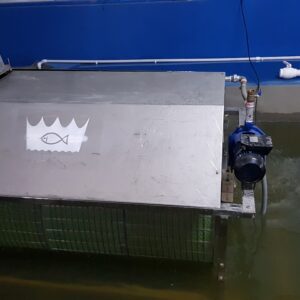
Description
What is a fish farming biofilter? A comprehensive review of its function, types, components, applications, pricing, and purchasing process.
In fish farming systems, water quality is a critical factor influencing aquatic health, fish growth, mortality rates, and the overall sustainability of the farming operation. Throughout their growth cycle, fish not only consume oxygen but also release various waste products into the water. Ammonia is one of the most significant of these compounds; elevated concentrations can create adverse conditions for the fish.
While water exchange can remove some of these compounds in simpler systems, relying solely on water replacement is not a viable solution for high-density systems—particularly in Recirculating Aquaculture Systems (RAS). In such scenarios, biological water treatment becomes essential.
A fish farming biofilter—or biological filter—is a device that creates a suitable environment for the growth and activity of nitrifying microorganisms, enabling the conversion of ammonia in the water into nitrite and subsequently into nitrate. Indeed, the biofilter is a key component in the management of nitrogenous compounds within many aquaculture systems.
In this article, we examine fish farming biofilters in terms of their structure, function, types, media, influencing parameters, selection criteria, maintenance, common issues, factors affecting price, and important considerations when making a purchase.
What is a fish farming biofilter, and what role does it play in water purification?
A biofilter is a biological treatment unit that provides suitable conditions for the colonization and growth of beneficial bacteria. These bacteria form a microbial layer—known as a biofilm—on the surface of the biological media.
The primary function of these microorganisms is to carry out the process of nitrification. During this process, highly toxic nitrogenous compounds, such as ammonia and nitrite, are converted into less harmful compounds.
Simply put, the operation of a biofilter can be visualized as follows:
Ammonia → Nitrite → Nitrate
This process enables the control of toxic nitrogenous compounds that enter the water as a result of fish activity and the decomposition of organic matter.
This process is of even greater importance in intensive farming systems, as the load of waste products—and consequently the system’s nitrogen load—increases alongside the quantity of fish and feed consumed.
How does a biofilter work in a fish farming system?
To better understand the function of a fish farming biofilter, we must first understand how nitrogenous compounds are generated in the water.
Fish release ammonia into the water through metabolism and waste excretion. Some of this ammonia also originates from the decomposition of organic matter, leftover feed, and excrement.
If this compound is not controlled in a timely manner, it can become a hazard to the system.
Water contaminated with nitrogenous compounds enters the biofilter. Here, the water comes into contact with filter media that provide a suitable surface area for the colonization of microorganisms.
Nitrifying bacteria residing on the media oxidize ammonia and convert it into nitrite. Another group of bacteria converts nitrite into nitrate.
Thus, the biofilter is essentially a bioreactor in which bacteria play the primary role in the treatment process.
What bacteria are found in a fish farming biofilter?
Nitrifying bacteria are a vital component of an active biofilter.
These bacteria grow on various surfaces within the system; however, a well-designed biofilter provides ample surface area to support their growth and maintenance.
In the first stage, ammonia-oxidizing microorganisms convert ammonia into nitrite.
In the next stage, nitrite-oxidizing bacteria convert nitrite into nitrate.
Therefore, the mere presence of a tank or chamber filled with media does not mean the biofilter is active. A biofilter performs its actual function only when an adequate population of nitrifying microorganisms has become established within it.
Research on RAS (Recirculating Aquaculture Systems) has also shown that the biofilm formed on the biofilter media plays a crucial role in removing ammonium and controlling nitrogenous compounds.

What is biofilter media, and why is it so important?
Biofilter media is the substrate upon which beneficial bacteria colonize.
One of the most important characteristics of biological media is the surface area available for biofilm growth. The more the media’s design facilitates a greater effective surface area for microorganism colonization, the higher its potential for the nitrification process.
However, there is an important point to consider:
A higher specific surface area does not, in itself, guarantee better performance.
In addition to an adequate surface area, the media must allow for proper water flow, ensure bacterial access to oxygen and nutrients, and offer sufficient mechanical strength and operational practicality.
If the media becomes overly dense or water pathways become obstructed, a portion of the media’s surface area will effectively be removed from the treatment process.
Therefore, when selecting a biofilter for fish farming, one should not focus solely on the stated specific surface area; rather, the overall system performance, the type of media, and operational conditions must also be evaluated.
What is the function of a biofilter in a Recirculating Aquaculture System (RAS)?
In Recirculating Aquaculture Systems (RAS), a significant portion of the water is returned to the culture unit after undergoing treatment.
Such systems typically employ multiple treatment processes in tandem.
First, solids and suspended particles must be removed from the water. Subsequently, biological processes are carried out to manage dissolved compounds—specifically nitrogenous compounds.
For this reason, the biofilter is generally a key component of the treatment train in RAS systems.
In a sound design, the biofilter should not be viewed as a piece of equipment independent of the system’s other components. Water flow rate, mechanical filtration, aeration, oxygenation, disinfection, solids management, and nitrate control can all influence the system’s overall performance.
What is the difference between a fish farming biofilter and a mechanical filter?
These two pieces of equipment serve different functions.
A mechanical filter is used to separate particles and solid matter from the water.
A biofilter is used for biological purification and the conversion of nitrogenous compounds with the help of microorganisms.
Therefore, a biofilter cannot fully replace a mechanical filter.
If a large amount of solids enters the biofilter, there is a risk of media clogging and the creation of unfavorable conditions for the biofilm.
For this reason, in many systems, removing solids before the water enters the biological stage is crucial. RAS systems also typically employ a combination of solids removal and biological treatment.
Why is it a mistake to select a biofilter based solely on tank volume?
Imagine two farms with identical water volumes.
If one farm stocks more fish and consumes more feed, the pollution load and ammonia production are likely to be higher.
Consequently, the two systems may require vastly different biological filtration capacities.
For this reason, when purchasing a biofilter for fish farming, it is best to provide the designer or supplier with the project’s actual specifications.

How does water flow rate affect biofilter performance?
Water must pass through the biofilter at an appropriate flow rate.
If the flow rate is too low, the volume of water treated per unit of time decreases, and water distribution within the system may be inadequate.
On the other hand, excessively high flow does not necessarily equate to improved performance; it can alter the water’s contact time with the media and the hydraulic conditions of the bed.
Studies on RAS biofilters have shown that flow velocity can significantly impact TAN and nitrite removal rates.
Therefore, the flow rate must be determined based on the specific type of biofilter, the media used, and the system design.
Frequently Asked Questions About Fish Farming Biofilters
What is a fish farming biofilter?
A biofilter is a biological treatment unit that facilitates the conversion of ammonia into nitrite and subsequently into nitrate by providing a suitable surface area for the growth of nitrifying bacteria.
What substances does the biofilter remove from the water?
The primary function of a nitrifying biofilter is the conversion of ammonia and nitrite. A biofilter alone does not replace mechanical filtration, disinfection, or nitrate removal systems.
Does the biofilter remove ammonia?
In reality, the biofilter primarily converts ammonia into other nitrogenous compounds through the biological process of nitrification. This technical distinction is important.
What is the difference between a biofilter and a mechanical filter?
A mechanical filter is designed to remove particles and solid matter, whereas a biofilter processes dissolved nitrogenous compounds through microbial activity.
What is the best type of biofilter for fish farming?
No single type of biofilter can be considered the best for every project. The appropriate type depends on capacity, fish species, feeding rate, temperature, flow rate, and system design.
Is a biofilter suitable for a RAS?
Yes. The biofilter is a crucial component of Recirculating Aquaculture Systems (RAS) and is used to control nitrogenous compounds within them.
Can the biofilter’s capacity be increased in the future?
This depends on the initial design, the type of system, the tank capacity, and the feasibility of expanding the media and equipment. If future expansion is anticipated, it is best to incorporate it into the design from the start.

Conclusion: Selecting the Right Biofilter for a Fish Farming System
A fish farming biofilter is a crucial component of biological water treatment in aquaculture; its primary role is to create optimal conditions for the activity of nitrifying bacteria, facilitating the conversion of ammonia into nitrite and subsequently into nitrate.
The actual performance of a biofilter depends on various factors, such as the type and quantity of filter media, bio-load, feed rate, water flow rate, dissolved oxygen levels, temperature, pH, alkalinity, and operational conditions.
Therefore, the selection of a biofilter should not be based solely on tank volume, the unit’s appearance, or its price.
When purchasing a fish farming biofilter, it is best to first determine the project’s actual requirements and then select the appropriate capacity, biofilter type, media, and auxiliary equipment.
Ultimately, if you are looking for a genuine fish farming biofilter, evaluating technical specifications and the product’s compatibility with your farming system is more important than making a choice based solely on price. Kian Abzi Company can also provide the necessary information to help you evaluate and select the right equipment based on your project specifications.